by
by 
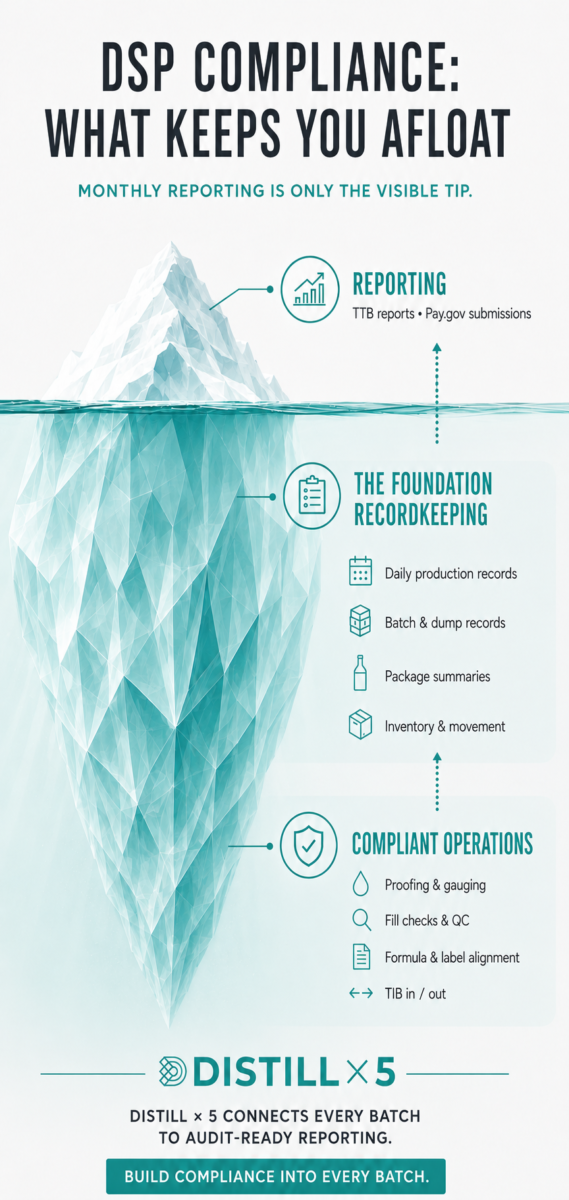
The Iceberg
Look at an iceberg from a boat, and you see maybe 10% of it. The other 90% is underwater, hiding just below the surface. TTB compliance works the same way. Your monthly reports are the tip and recordkeeping and daily operations are the mass underneath. It’s ignoring what’s underneath that sinks a distillery, not what’s above the waterline.
More and more, distillers are building their own compliance layer instead of buying one. An AI copilot here, a custom GPT there, a spreadsheet stack held together with macros and muscle memory. It feels fast. It feels free. And it can, in fact, produce something that looks like a report.
We’re not here to talk anyone out of AI, because it’s genuinely good at what it’s good at. The real question is narrower: is a general-purpose AI tool the right tool for carrying your compliance backbone alone? For most distilleries, the answer is no.
Here’s how the three approaches compare on the things an auditor checks:
| What an Auditor Checks | DIY AI Copilot | DIY Spreadsheet Stack | DISTILL x 5 (Dx5) |
| Audit trail of changes | Rarely, not enforced | Not by default | Yes |
| Locked units (proof gallon vs. wine gallon) | No | Rarely enforced | Yes |
| Consistent answers over time | No, shifts with model updates | Yes, but errors replicate silently | Yes, validated |
| Tested against real TTB audits | No | No | Yes |
A DIY system can pass its own test. An audit is a different test.
What General AI Is Built to Do Well
General AI is built to draft fluently, not to verify legal facts. That’s a real mismatch for TTB compliance, where a wrong answer often doesn’t look wrong.
A general-purpose AI model predicts the next statistically likely word based on patterns in its training data. That’s an enormously useful skill for drafting an email or summarizing a document. Confidence and correctness are two separate variables in how these models work, and general models are optimized for the first one. That’s the design, not a flaw.
The mismatch shows up when a task needs verification more than fluency: dense, jurisdiction-specific, low-frequency text where the model has seen little training data. TTB compliance is exactly that kind of task.
In a 2024 study, researchers at Stanford RegLab and the Stanford Institute for Human-Centered AI found that general-purpose language models hallucinated on a majority of specific legal case-law queries, with older or smaller models running as high as the high 80s. Even the strongest model tested still hallucinated more often than not.
Legal research isn’t TTB compliance, but it’s the same shape of problem.
In practice, applying a general model directly to compliance can look like:
- Invented or misquoted CFR citations
- Confidently wrong proof-gallon math
- Fabricated “TTB guidance” that doesn’t exist
- Different answers to the identical question, asked twice
- Answers that shift again the next time the model updates, which means a system you tested once isn’t validated forever
In most categories, that kind of miss is an embarrassing edit, easily caught and corrected. In excise tax, it’s a filing error, and filing errors are exactly what an audit is designed to catch. The technology isn’t defective. It’s just being asked to do a job outside what it was designed to do well.
Language Is Law, Not Style
Proof gallon, tax-determined, and bonded are legal terms, not everyday vocabulary. General AI models don’t reliably tell them apart from casual usage.
This industry runs on words that carry legal weight most software categories never have to think about: proof gallon versus wine gallon, tax-determined versus tax-paid, bonded versus in-bond, rectification versus blending, “gauge” as a legal verb instead of a dashboard icon, and exact TTB form numbers.
A general AI model has seen “gauge” used as an instrument reading far more often than as the legal term for measuring spirits. So the statistically likely output is the wrong one, delivered fluently, with no flag telling you it’s wrong. That’s a training-data problem, not a trust problem.
Spreadsheets fail the same test from a different direction, and this isn’t an AI-specific risk at all. A column labeled “Proof Gal” with no unit lock will accept wine gallons without complaint. Nobody notices until the totals stop reconciling, and by then it’s not one bad cell. It’s a quarter of bad cells.
Bad Process and Data In, Bad ReportING Out
A report is only as accurate as the operations and records underneath it. No AI model and no spreadsheet formula can fix bad data at the source.
Reporting sits on top of recordkeeping. Recordkeeping sits on top of operations. You can’t automate your way to an accurate report, with AI or without it, while skipping the two layers underneath it.
A DIY build that only targets the visible tip, generating the monthly filing a little faster, is decorating the part of the iceberg everyone can already see. If proofing and gauging, fill-check QC, formula and label data, and TIB in/out records aren’t clean at the operations layer, no model and no formula makes the number at the top honest. It just gets the wrong number faster, and sounds more sure of itself while doing it.
SOPs are what bridge operations to records. The Pay.gov extension is what bridges records to reporting. DIY builds tend to skip both bridges and reach straight for the output.
Spreadsheets Have Their Own Failure Modes
Spreadsheets fail distillery compliance in five specific ways, independent of AI:
- No audit trail: no record of who changed a number, when, or why
- Silent formula errors that replicate across a full year of production records before anyone catches them
- Version chaos: the “real” file lives on one laptop, and everyone hopes it’s the current one
- A single point of institutional knowledge: the system only works because one person understands it, which is a continuity risk, not a compliance system
- End-of-day or end-of-week batch entry instead of logging the production day as it happens, exactly where entries get forgotten or backfilled from memory
Where AI Earns Its Place in Compliance
AI is a strong assist layer for compliance work. It’s not a substitute for a validated system of record.
Used well, AI drafts an SOP for review, summarizes a long CFR section into plain language, or flags a production log entry that looks unusual so a person can check it. A person, or a validated system like DISTILL x 5, still makes the call. AI just makes getting there faster.
The failure mode isn’t AI assisting the work. It’s AI replacing the system of record, where a fluent, unverified answer stands in for a legally defensible one with nobody checking it against ground truth.
What “Battle-Tested” REALLY Means
DISTILL x 5 (Dx5) started with a founder who had run distillery operations firsthand, and the first version of Dx5 grew out of that hands-on experience rather than an outside guess at the workflow. It’s been refined against real world experience in over a thousand distilleries in the over 15 years since.
Many traditional developers have worked on Dx5 in that time, but every release is led by customer validation with working distillers, refined against real audits and real edge cases: sugared spirits, TIB, multi-DSP operations, blending, over years, not a theoretical test plan.
That stress-testing has already happened, across roughly a thousand distillery floors. That’s not a claim a general-purpose skill or workflow can make yet, no matter how capable the underlying model is today.
Common Questions About DIY Compliance and AI
No. General AI tools are good at drafting and summarizing, but they aren’t validated against TTB’s specific legal definitions, and they can hallucinate on compliance-specific questions. DISTILL x 5 (Dx5) is compliance software built and validated for distillery recordkeeping and reporting.
Spreadsheets have no audit trail, no unit validation, and often depend on one person’s institutional knowledge to work correctly. A mislabeled column, like a “Proof Gal” field that accepts wine gallons, can go unnoticed for a year before the totals stop reconciling.
DISTILL x 5 (Dx5) is compliance and production software from FIVE x 5 (Fx5), built specifically for craft distilleries. It connects daily production records to audit-ready TTB reporting and has been refined against real audits and edge cases for 15 years.
A DIY system can produce something that looks like a report. Whether the records and operations underneath that report are clean enough to survive an audit is a different question. If they aren’t, no model or formula makes the number at the top defensible.